
Most dangers at home are ordinary ones: a smoke alarm with a flat battery, a socket that runs hot, bleach in a low cupboard, or a front door held shut by a flimsy frame. The good news is that most of them are cheap and quick to fix.
This guide explains how to make your home safer in seven practical steps, covering fire and gas, electricity, children, clutter and intruders. It finishes with what to look for in a front door that has to cope with the weather as well as break-in attempts.
Quick answer
To make your home safer, start with the steps that protect lives. Fit working smoke alarms near bedrooms and on every level, add a carbon monoxide (CO) alarm if anything in or attached to your home burns fuel, and make a fire escape plan that everyone has practised. Then fix electrical warning signs, lock away chemicals and medicines, clear clutter from exits and heaters, and strengthen your entry points with a solid, well-fitted door, a way to see visitors before you open up and, if it suits your situation, an alarm system.
|
Priority |
Step |
Why it matters |
|
1 |
Smoke and CO alarms |
Early warning of fire and an invisible, odourless gas |
|
2 |
Fire escape plan |
Gets everyone out quickly, including children |
|
3 |
Electrical checks |
Catches overheating and faulty wiring early |
|
4 |
Safe storage of chemicals and medicines |
Prevents accidental poisoning |
|
5 |
Clear clutter |
Removes fire fuel and keeps exits open |
|
6 |
Intercom, door viewer or video doorbell |
Lets you check visitors without opening the door |
|
7 |
Intruder alarm |
Deters and alerts you to break-ins |
1. Fit and maintain smoke alarms and carbon monoxide alarms
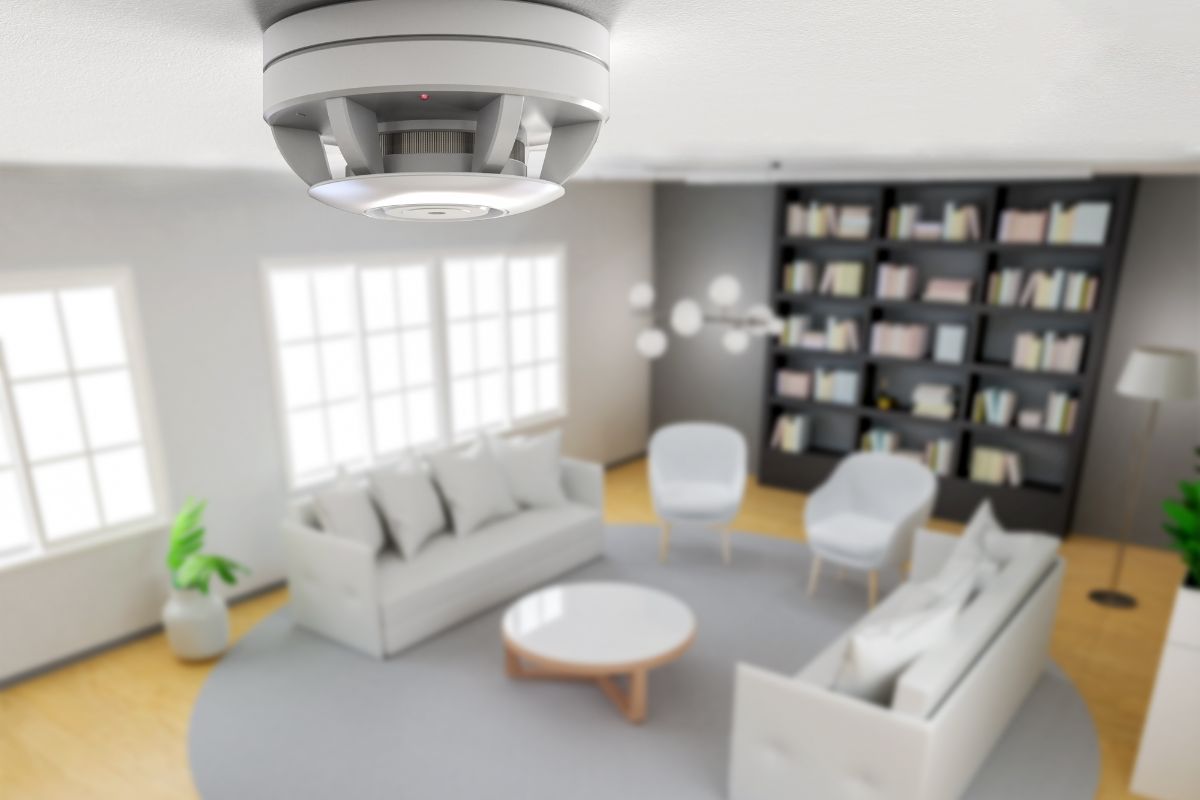
Working alarms are the single most important safety step in most homes. The US National Fire Protection Association (NFPA) reports that working smoke alarms cut the risk of dying in a home fire roughly in half.
NFPA’s guidance on smoke alarms is:
- Install them inside each bedroom, outside each sleeping area (such as a hallway) and on every level of the home.
- Mount them on the ceiling or high on a wall, following the manufacturer’s instructions.
- Interconnect them where possible, so that when one sounds, they all sound. This matters most if people sleep with bedroom doors closed.
- Test every alarm at least once a month using the test button.
- Replace each alarm 10 years after the manufacture date printed on the back, even if it still beeps when tested.
Rules differ between countries and states. Some require hardwired, interconnected or photoelectric alarms, especially in new builds and rentals, so check what your local fire service or building authority requires.
What is the difference between a smoke alarm and a CO alarm?
A smoke alarm senses smoke from a fire. A carbon monoxide alarm senses carbon monoxide, a poisonous gas produced when fuel such as gas, oil, wood or petrol burns incompletely. CO has no colour, smell or taste, so you cannot rely on your senses to notice it. Neither type of alarm prevents a fire or a gas leak; both give you an early warning so you can get out.
Some devices combine both sensors. The label on the alarm tells you which hazards it detects.
How to use CO alarms safely
- Fit a CO alarm near sleeping areas if your home has a gas, oil or wood-burning appliance, a fireplace, or an attached garage.
- The US Centers for Disease Control and Prevention (CDC) advises a battery-operated or battery back-up CO alarm, with the battery checked or replaced each spring and autumn.
- Have fuel-burning heaters, boilers, water heaters and stoves serviced by a qualified technician every year.
- Never run a generator, charcoal barbecue or camp stove indoors, in a garage or near a window, and never run a car in an attached garage, even with the door open.
- Replace the alarm by the date shown on the unit. Lifespans vary by model, commonly between about five and ten years.
If a CO alarm sounds: get everyone outside into fresh air, call your emergency number and stay out until emergency services say it is safe. Seek medical help if anyone has a headache, dizziness, nausea or confusion.
2. Make a fire escape plan and teach children what to do
A fire escape plan is a simple agreement about how everyone gets out and where you meet. It matters because NFPA estimates that, in a typical home fire, you may have as little as one to two minutes to escape once the smoke alarm sounds.
To make a plan:
- Draw a simple floor plan of your home with everyone in the household.
- Mark two ways out of every room, usually a door and a window.
- Choose a meeting place outside, such as a letterbox or a neighbour’s gate.
- Check that windows, security screens and grilles on escape routes can be opened quickly from inside without hunting for a key.
- Practise at least twice a year, including once at night.
When teaching children, keep the messages short and age-appropriate:
- Know what the smoke alarm sounds like, and get out straight away when it sounds.
- Never hide under a bed or in a cupboard, and never go back inside for toys or pets.
- Call the emergency number from outside (for example, 000 in Australia, 911 in the United States, or 112 in India and across the European Union).
- Use the intercom or door viewer to answer the door, and don’t open it to strangers.
Young children do not always wake to a smoke alarm, so decide in advance which adult helps each child, older relative or anyone with limited mobility. Fire extinguishers and fire blankets are useful for adults who have learned to use them on very small fires, but the priority for children is always to get out.
3. Watch for electrical warning signs
Electrical faults are a common cause of house fires, and the warning signs are often easy to spot. Call a licensed electrician if you notice:
- Lights that flicker or dim, especially when an appliance switches on
- Switches, sockets or wall plates that feel warm or look discoloured
- Circuit breakers that trip often, or fuses that keep blowing
- Buzzing, crackling or sizzling sounds from sockets or switches
- A burning or hot-plastic smell, sparks, or mild shocks from appliances
If it is safe to do so, unplug the affected appliance or switch off that circuit at the switchboard until it has been checked.
Everyday habits also help. Plug large appliances such as heaters and fridges directly into a wall socket. Remember that a power board adds sockets, not extra capacity, and replace cords that are frayed or damaged. Ask your electrician to confirm that your home is protected by a safety switch (called an RCD in Australia and the UK, or a GFCI in the US) and to test it.
Leave fixed wiring to a professional. In many places, including Australian states, most electrical work legally requires a licensed electrician. If your home is older or you have never had the wiring checked, an inspection is a sensible first step.
4. Store chemicals and medicines where children can’t get them
Young children explore by touching and tasting, and they can climb and open cupboards earlier than many parents expect. Poisons information centres in Australia recommend storing medicines and household chemicals at least 1.5 metres high, in a locked or child-resistant cupboard.
- Move cleaners, dishwasher tablets and laundry pods out of the cupboard under the sink.
- Keep products in their original labelled containers, and never pour chemicals into drink bottles or cups.
- Put products away straight after use. Child-resistant caps slow children down, but they are not childproof.
- Keep handbags, including visitors’ bags, out of reach, because they often contain medicines.
- Store garden sprays, fuel and paint in a locked cupboard in the shed or garage.
- Take unwanted or out-of-date medicines to a pharmacy for safe disposal.
If you think a child has swallowed something harmful: call your local poisons information line straight away (13 11 26 in Australia, or Poison Help on 1-800-222-1222 in the United States). If the child is unconscious, having trouble breathing or having a seizure, call your emergency number first.
5. Clear clutter that feeds a fire or blocks a way out
Old furniture, stacks of newspapers and piles of cardboard boxes do not start fires on their own, but they give a fire more fuel and can block the route out. Clutter near heaters, stoves and electrical appliances is the biggest concern.
- Keep anything that can burn at least 1 metre (about 3 feet) away from heaters, fireplaces and stoves.
- Store paint, fuel and aerosols away from heat sources and appliances, and keep only what you need.
- Keep hallways, stairs and doorways clear so nobody trips in the dark or in smoke.
- Set a regular time, such as each change of season, to clear out the garage, storage areas and spare rooms.
Piles of paper and cardboard can also give pests somewhere to nest. If you already have a problem, our guide to choosing a pest control company explains what to check before you hire one.
6. See who is at the door before you open it
Being able to check and talk to a visitor without opening the door is a simple security upgrade. Options include:
- Door viewer (peephole): inexpensive and works without power.
- Audio or video intercom: common in apartment buildings, where it lets residents check visitors at the main entrance.
- Video doorbell: shows the doorstep on your phone and lets you speak to visitors or couriers when you are not home.
Before buying a connected device, check your Wi-Fi signal at the door and whether recordings require a paid subscription. Change any default passwords, keep the firmware updated, and point cameras at your own property. Privacy rules on recording neighbours or public areas vary, so check what applies where you live. Renters may need the landlord’s permission to install one.
7. Choose an intruder alarm that suits your home
An intruder alarm system usually includes a control panel, sensors on doors and windows, motion detectors and a siren. You can choose between:
- Unmonitored alarms, which sound a siren and may send alerts to your phone. They cost less, but rely on you or your neighbours to respond.
- Monitored alarms, where a monitoring centre contacts you, a guard service or the police when the alarm is triggered. They involve an ongoing fee.
There is some evidence that visible alarms deter burglars. In a survey of 422 imprisoned burglars in the United States, carried out by researchers at the University of North Carolina at Charlotte and funded by the alarm industry’s research foundation, about 60% said an alarm would lead them to choose another target, and around 83% said they would try to find out whether a home had one. This is self-reported and industry-funded, so treat it as an indication rather than proof.
When comparing systems, ask about contract length, what happens when the alarm is triggered, how false alarms are handled (some areas fine repeat false alarms), pet-friendly sensors and whether your home insurer offers a discount. An alarm works best alongside good locks, outdoor lighting and a strong front door.
Windows deserve attention too, because they can be easier to force than a good door. Key-operated locks or restrictors on accessible windows help. Our article on double glazed awning windows covers one window style that can be fitted with restrictors and multi-point locks. Keep at least one window in each bedroom that adults can open quickly from inside as an escape route.
How to choose a secure, weatherproof front door
The front door of a house works harder than an apartment door inside a corridor. It faces rain, sun, wind and big temperature differences between inside and outside, as well as forced-entry attempts. That is why a door designed and rated for exterior use is the safer choice.
What problems do external doors face?
|
Problem |
What happens |
How to prevent it |
|
Condensation |
Warm, moist indoor air meets a cold metal skin or frame and forms water droplets on the inside |
Choose a thermally broken door (one with an insulating barrier between the inner and outer metal), good seals, and ventilation to control indoor humidity |
|
Freezing and sticking |
In sub-zero climates, condensation or rain freezes in the seals, frame or threshold |
Choose a thermal break, keep seals and the threshold adjusted, and keep drainage paths clear |
|
Corrosion (rust) |
Moisture reaches bare metal through scratches or a damaged finish |
Choose galvanised steel or aluminium with a durable exterior coating, touch up scratches promptly, and use hardware suited to coastal areas if you live near the sea |
|
Peeling or cracking finish |
A finish not designed for exterior use breaks down, letting moisture in |
Ask for a finish rated for exterior use and check what the warranty covers |
|
Sun fading |
UV light changes the colour and weakens some coatings |
Choose a UV-stable finish, add shade such as a porch or awning, or pick a lighter colour for a sunny side |
A door’s main jobs are to keep heat, cold, dust and noise out, and to stop it being the weak link in your home’s security. Any glass in or beside it should be safety glass, ideally laminated so that it holds together when broken. If you are considering glazing, our guide to double glazed entrance doors explains the ratings and features worth comparing.
Which front door material is most secure?
Steel offers the strongest outer skin, but the material matters less than the complete doorset: the frame, hinges, locks and installation.
|
Material |
Strengths |
Watch-outs |
|
Steel |
Very strong, usually less expensive |
Can dent; may rust if the coating is damaged; conducts cold unless insulated and thermally broken |
|
Fibreglass or composite |
Resists dents, rot and warping; insulates well; can mimic timber |
Security depends on the core and frame reinforcement; often costs more than steel |
|
Solid timber |
Strong when solid hardwood; traditional look |
Needs regular refinishing; can swell, shrink or warp |
|
Aluminium |
Resists corrosion; suits large glazed designs |
Needs a thermal break in cold climates and a robust multi-point lock |
Security features to check
- Frame and strike plate: the strike plate is the metal plate the bolt locks into. Choose a reinforced one fixed with long screws that reach the wall framing behind the door frame, not just the thin jamb. Many locksmiths recommend screws of around 75 mm (3 inches) or longer.
- Hinges: use long screws here too. Hinge bolts or security studs help on doors that open outwards, where the hinge pins are outside.
- Locks: a deadbolt or multi-point lock (which bolts the door at several points along the frame), with a good-quality cylinder that resists picking, bumping and snapping.
- Tested ratings: in Europe, the EN 1627 standard grades complete doorsets from RC1 to RC6. An RC2 door is tested to resist simple tools such as screwdrivers and wedges for about three minutes, and an RC3 door to resist a crowbar for about five minutes. RC2 or RC3 is commonly recommended for homes. Other countries use their own standards, so ask which one a door meets and whether the whole doorset was tested.
- Installation: a strong door in a poorly fixed frame is still easy to force. Use an experienced installer and get the warranty in writing.
Home safety maintenance checklist
|
How often |
Task |
|
Monthly |
Test all smoke and CO alarms |
|
Twice a year |
Practise your fire escape plan; check CO alarm batteries; check door seals, hinges and window locks |
|
Yearly |
Service fuel-burning appliances; check alarm expiry dates; clear out garage and storage areas; touch up scratches on external doors |
|
Every 10 years |
Replace smoke alarms |
|
Whenever you notice warning signs |
Call a licensed electrician or gas fitter |
A safer home, one step at a time
You don’t need to do everything this weekend. Start with working smoke and CO alarms and a practised escape plan, because those protect lives. Then work through electrical checks, safe storage, decluttering and your front door as time and budget allow. For more practical advice on looking after your property, browse our home improvement guides.