If you are looking for warehouse or logistics work, job adverts will often ask for a “counterbalance licence” or a “reach licence”. If you employ forklift operators, you need to know which training covers which truck.
This guide explains the main forklift licence categories used in the UK, what each truck does, how training works, how long it takes, what it typically costs and when you need a refresher.
Quick answer
The UK has no government-issued forklift licence. What people call a forklift licence is a certificate of training for one specific type of truck, usually issued by a training provider accredited by a recognised body such as RTITB, ITSSAR, AITT, NPORS or Lantra Awards.
Training categories are grouped by truck type. The most common are counterbalance (codes B1 to B3), reach trucks (D1), pivot steer or articulated trucks (P1) and multi-directional trucks (M1 to M4). A certificate for one category does not cover another, so moving to a new truck type means conversion training.
A novice counterbalance course typically lasts three to five days. Published UK prices in 2025–26 ranged from roughly £370 to £720, and one-day refreshers from about £160 to £240.
What people mean by a “forklift licence”
A forklift licence, sometimes called an FLT licence, is really a record that you have passed basic operator training on a particular truck. The Health and Safety Executive (HSE), the UK’s workplace safety regulator, states plainly that there is no such thing as a lift-truck licence.
The legal duty sits with employers. Under the Provision and Use of Work Equipment Regulations 1998 (PUWER), employers must make sure anyone using work equipment has adequate training. For forklifts, the HSE’s Approved Code of Practice L117, Rider-operated lift trucks, sets out the standard that training should meet.
In practice, this means three things:
- Basic training and testing on the type of truck you will use.
- Job-specific and familiarisation training on your employer’s own trucks, site and tasks.
- Written authorisation from your employer before you operate a truck on their premises.
Your certificate proves the first part. Each employer is still responsible for the other two.
Forklift licence categories at a glance
Most UK accrediting bodies use a shared set of category codes agreed by the Accrediting Bodies Association for Workplace Transport (ABA). The table below summarises the ones you are most likely to see in job adverts and course listings.
|
Truck type |
ABA code |
What it does |
Where you usually see it |
|
Counterbalance |
B1 (up to 5,000kg), B2 (over 5,000kg up to 15,000kg), B3 (above 15,000kg) |
Forks at the front, heavy counterweight at the back |
Loading bays, factories, yards, general warehousing |
|
Reach truck |
D1 |
Mast moves forward to place pallets in high racking |
Indoor warehouses with tall racking |
|
Pivot steer (often called articulated, “Bendi” or “Flexi”) |
P1 |
Front section pivots so the forks can face racking in a narrow aisle |
Narrow-aisle warehouses, some yard work |
|
Multi-directional |
M1 to M4 |
Wheels turn so the truck can travel sideways |
Long loads such as timber, pipes and steel |
|
Sideloader |
C1 to C3 |
Load is carried along the side of the truck |
Long loads in yards and wide aisles |
|
Very narrow aisle (VNA) |
F1 (operator up), F2 (operator down) |
Works in very tight aisles, often on guide rails |
High-density warehouses |
|
Order picker |
E0 to E2 |
Lifts the operator to pick individual items |
Picking operations in warehouses |
|
Rough terrain and telescopic |
J1, J3, J5, J7, J8 |
Masted or telescopic-boom trucks for uneven ground |
Farms, builders’ merchants, construction sites |
|
Powered pallet trucks and stackers |
A1 to A7 |
Low-level or stacking work, walk-behind or ride-on |
Shops, loading bays, small warehouses |
|
Vehicle-mounted lift truck |
T (with the nearest category, for example T(B1)) |
Carried on the back of a lorry and unloaded on delivery |
Building materials deliveries |
Source: ABA Workplace Transport Groupings, version 10.1224. The ABA updates this list from time to time, so check the current version with your training provider.
The main forklift types explained
Counterbalance forklifts (B1, B2, B3)
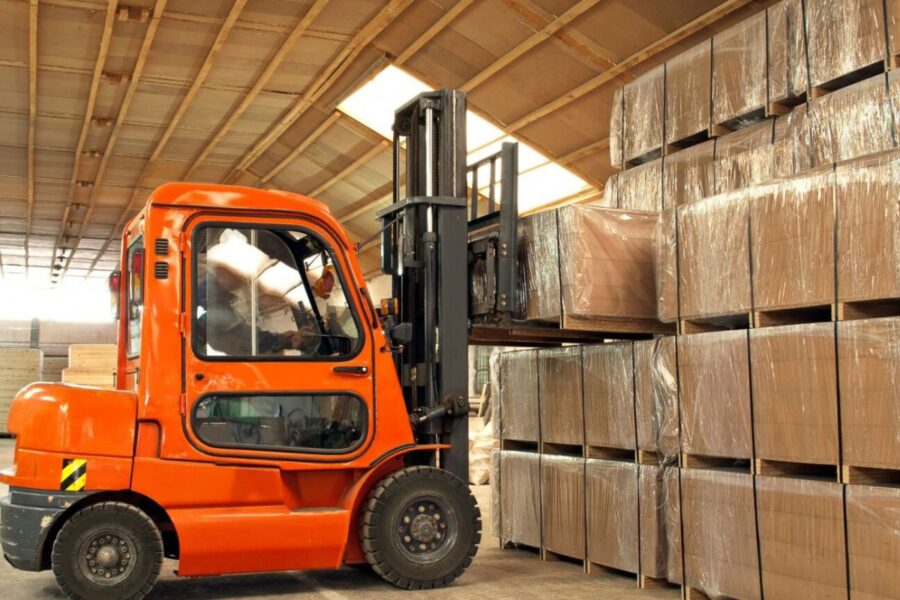
The counterbalance truck is the classic forklift. The forks sit at the front, and a heavy weight at the back balances the load. Because there are no supporting legs at the front, it can drive right up to a lorry or a stack.
Counterbalance trucks run on electric, diesel or LPG (liquefied petroleum gas) power and work indoors and outdoors. That versatility is why counterbalance is the certificate most entry-level job adverts ask for.
The code depends on the truck’s rated capacity. Most warehouse trucks fall under B1, which covers trucks up to and including 5,000kg.
Reach trucks (D1)
A reach truck has two support legs at the front and a mast that slides forward to “reach” into racking. It can lift loads much higher than a typical counterbalance truck and turn in narrower aisles.
Reach trucks are designed mainly for indoor use on smooth floors. They are common in distribution centres with tall racking. Safe high stacking also depends on the load itself. Our guide to how corrugated box strength is tested explains why boxes at the bottom of a stack can fail.
Articulated or pivot steer forklifts (P1)
These trucks are often sold under names such as Bendi or Flexi. The front section, including the mast, pivots on the chassis. That lets the operator turn the forks to face racking without turning the whole truck.
The result is a truck that can work in narrow aisles, a little like a reach truck, but that is often also suited to yard surfaces. The official ABA term is pivot steer truck.
Do not confuse this with category J8, the articulated telescopic loader with fork arms used in agriculture and construction. That is a different machine with its own training.
Multi-directional forklifts (M1 to M4)
Multi-directional trucks can drive forwards, backwards and sideways because their wheels turn through 90 degrees. This makes them ideal for long loads, such as timber or pipes, that need to pass through doorways or along narrow aisles lengthways.
Despite the similar narrow-aisle use, they work very differently from pivot steer trucks. They need separate training.
Other categories you may come across
- Telescopic handlers (telehandlers) use an extending boom instead of a mast. Construction sites often expect a plant card scheme such as CPCS or NPORS rather than a warehouse forklift certificate.
- Order pickers and VNA trucks lift the operator, so training covers working at height and, in VNA aisles, guidance systems.
- Powered pallet trucks and stackers look simple, but they are still work equipment that requires training.
Which category should you train on first?
It depends on the work you want. Counterbalance is usually the most flexible starting point, because it is used in so many workplaces and appears in many job adverts.
Choose reach first if a job offer or local employer specifically needs it. If you want to work on construction sites, look at telehandler training through a construction plant scheme instead.
If you are an employer, train people on the categories they will actually use. A business moving into palletised deliveries may need only a powered pallet truck or a B1 counterbalance truck. Our packaging materials checklist for e-commerce businesses covers the other half of getting goods safely out of the door.
How to get forklift trained in the UK
- Decide on the truck type. Match the category to the job you want or the truck your employer uses.
- Choose a credible training provider. Look for accreditation from an ABA member body. Accreditation is voluntary, but it gives some assurance the course meets the L117 standard.
- Pick the right course level. Novice, experienced operator, conversion and refresher courses differ in length and price (see the table below).
- Complete theory and practical training. Courses cover controls, stability, load handling, pre-use checks and safe driving. HSE guidance on lift-truck training says training should always include basic, job-specific and familiarisation stages, and that a novice basic course typically lasts three to five days.
- Pass the tests. Expect a theory test, a pre-use inspection check and a practical driving test.
- Keep your certificate safe. Accredited bodies usually register your training, so a new employer can check it. RTITB certificates, for example, carry a nine-digit registration number.
- Get site training and written authorisation. Every employer must give you job-specific and familiarisation training before you work unsupervised.
How long does forklift training take?
Course length depends on your experience and the number of trainees per instructor. The HSE suggests a maximum of three trainees per instructor and truck for practical sessions.
|
Course |
Who it is for |
Typical length |
|
Novice |
No previous forklift experience |
3 to 5 days |
|
Experienced operator |
Some experience, but no accredited certificate |
Often 2 to 3 days |
|
Conversion |
Certified operators adding a new truck type |
Often 1 to 3 days |
|
Refresher |
Certified operators updating their skills |
Usually 1 day |
These lengths are typical, not fixed. Your instructor may recommend more time if you need it.
How much does forklift training cost?
Prices vary by region, truck type, course length and whether training happens at a centre or on your employer’s site. Published prices from UK colleges and accredited training centres in 2025–26 gave these rough ranges:
- Novice counterbalance: about £370 to £720.
- One-day refresher: about £160 to £240.
- Five-day CPCS telehandler course at CITB’s National Construction College: about £1,550 to £1,705.
Some providers add VAT or a separate certificate fee, so check what the quoted price includes. Many employers pay for training, and some colleges offer funded places for eligible learners.
Treat these figures as a guide only. Prices change, so always get a current quote.
Refresher training: how often do you need it?
There is no fixed legal expiry date for a forklift certificate. The HSE says employers can choose an automatic refresher or retest after a set period, giving three to five years as an example, while still monitoring operators in between.
Refresher training or retesting is also sensible when an operator:
- has not used a truck for some time
- is only an occasional user
- has developed unsafe habits
- has had an accident or near miss
- is working with new equipment, tasks or site layouts
In practice, many employers set their own three-year refresher policy. If your training is older than that, expect a new employer to ask for a refresher or retest.
How to choose a training course worth paying for
A good course will:
- name its accrediting body and give you a way to verify the certificate
- include hands-on time on the actual truck type, not just videos
- keep practical groups small, ideally no more than three trainees per instructor
- explain what the price includes, such as tests, certificates and VAT
Be cautious about any course that promises a “forklift licence” entirely online. Basic training needs supervised practical driving and a practical test, so an online-only course cannot meet the L117 standard on its own.
Final thoughts
The right forklift licence category is the one that matches the truck you will actually drive. Start with the category your target job needs, choose an accredited course with plenty of practical time, and keep your certificate and refresher dates in order.
If you are an employer, remember that the certificate is only the first step. Site training, written authorisation and regular monitoring are what keep operators and the people around them safe. For more practical workplace and small-business guides, browse our Business articles.