A box that collapses in a truck or splits at a corner costs far more than the box itself. This guide explains how corrugated box manufacturing works, using Avon Containers in Haryana as a worked example. You will learn what 3, 5 and 7 ply mean, which strength tests matter, how humidity affects boxes, and what to ask any supplier before you place an order.
The company details below come from Avon Containers’ own website and trade listings. The Care Diary has not inspected its plants or tested its boxes, so treat the company’s claims as claims to verify.
Quick answer
Good corrugated box manufacturing comes down to three things: the right board for the load, consistent paper quality, and regular testing. Avon Containers says it runs fully automatic 3, 5 and 7 ply lines, holds ISO 9001:2015 certification and tests boxes for bursting strength, compression, edge crush, paper weight (GSM), moisture and water absorption.
Those are the right tests to look for. Before you buy from Avon or any other maker, ask for recent test reports for your exact box, a sample to try on your own products, and clear answers on moisture control and recycled content.
Who is Avon Containers?
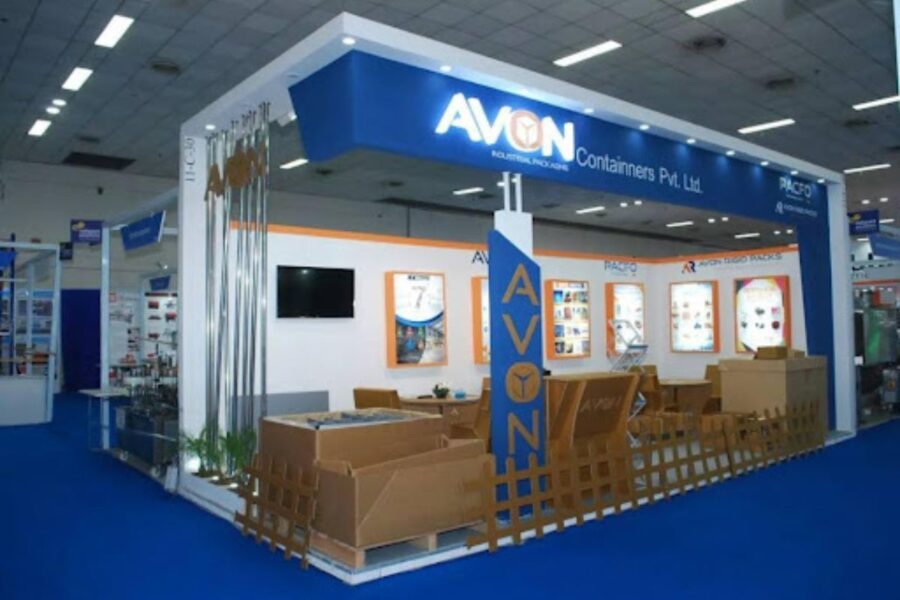
Avon Containers Pvt. Ltd. is an Indian packaging manufacturer that says it was founded in 1979. It markets itself as a corrugated box manufacturer in Faridabad. Its listed factory address is at Prithla, Sector 10, on the Delhi–Mathura Road in Palwal district, Haryana.
According to the company’s website:
- It began with a manual plant making about 50 tonnes of boxes a month in 1979.
- It added its first fully automatic double-wall (5 ply) line in 2005 and a triple-wall (7 ply) line in 2017.
- It now reports five plants and ISO 9001:2015 certification, the international standard for quality management systems.
- It added an offset printing line for printed mono cartons in 2023.
- Its range includes corrugated boxes, corrugated sheets and rolls, rigid boxes, printed cartons, paper courier bags, edge protectors, strapping, tapes, stretch film, wooden pallets and PP boxes.
A trade magazine, Packaging South Asia, has reported that a sister business, Avon Pacfo, was set up to serve smaller orders using the parent company’s production base. These are useful background facts, but they are not independent proof of quality. The rest of this guide shows how to check that for yourself.
How corrugated boxes are made
A corrugated box is made from corrugated board: one or more wavy paper layers, called fluting or medium, glued between flat paper sheets, called liners. The arches in the fluting give the board its stiffness and cushioning.
The basic process at most automated plants, including the one Avon describes, follows these steps:
- Paper selection. Kraft paper is chosen by GSM (grams per square metre) and burst factor, a measure of how strong the paper is for its weight.
- Corrugation. A corrugator forms the fluting with heated rollers and glues it to the liners with starch adhesive to make 3, 5 or 7 ply board.
- Cutting and creasing. The board is cut into sheets and scored so it folds cleanly.
- Printing and slotting. A flexo printer-slotter prints logos or handling marks and cuts the flaps.
- Joining. The box’s manufacturer’s joint is glued or stitched to form a flat box.
- Testing and dispatch. Samples are tested before the boxes are bundled and shipped flat.
Avon lists automatic corrugation lines, flexo printer-slotters and an automatic folder-gluer-stitcher among its machines. Automation tends to give more even glue lines and more consistent board, but the paper going in still decides most of the strength.
3 ply, 5 ply or 7 ply: which do you need?
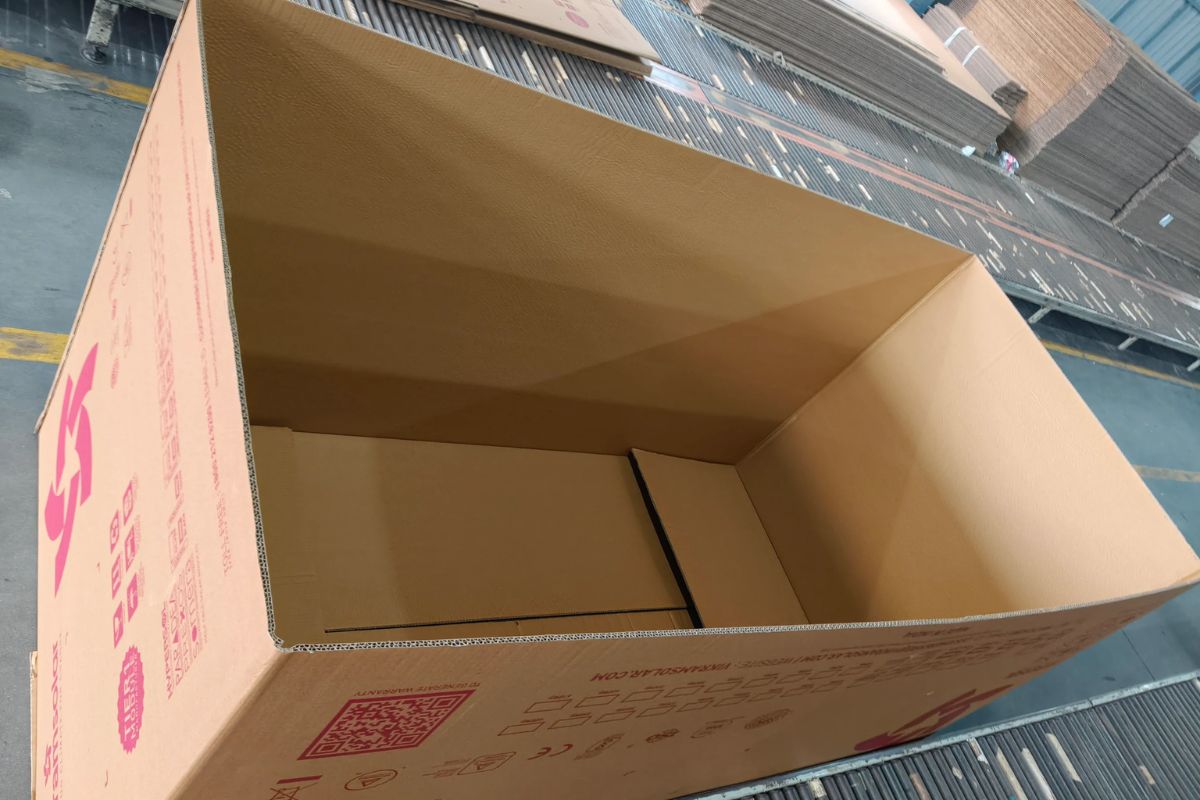
The right ply depends on how heavy the contents are, how high the boxes will be stacked and how rough the journey is. More ply means more strength and more cost, so the aim is a box that is strong enough, not overbuilt.
|
Board |
Also called |
Layers |
Typical uses |
|
3 ply |
Single wall |
2 liners + 1 fluting |
Light to medium products, e-commerce parcels, garments, retail goods |
|
5 ply |
Double wall |
3 liners + 2 fluting |
Heavier or fragile goods, appliances, electronics, longer transit |
|
7 ply |
Triple wall |
4 liners + 3 fluting |
Heavy industrial parts, machinery, export loads, bulk packing |
Ply is only a starting point. Two 5 ply boxes can perform very differently if one uses heavier, stronger paper. That is why the tests below matter more than the ply count alone.
How corrugated box strength is tested
Each test answers a different question about how a box will behave. Avon says its in-house lab has equipment for all of the tests below.
|
Test |
What it measures |
Why it matters |
|
Bursting strength |
Pressure needed to rupture the board |
Resistance to punctures and internal pressure in parcel handling |
|
Edge crush test (ECT) |
Force needed to crush a strip of board on its edge |
Predicts stacking strength |
|
Box compression test (BCT) |
Load a finished box can carry before collapsing |
The most direct check of stacking performance |
|
GSM test |
Weight of paper per square metre |
Confirms the supplier used the paper agreed |
|
Moisture meter |
Water content in the board |
Damp board is weaker |
|
Cobb test |
How much water the paper surface absorbs |
Shows resistance to humidity and spills |
In India, the main standard for these boxes is IS 2771 (Part 1):2022 from the Bureau of Indian Standards (BIS). The BIS summary of IS 2771 (Part 1):2022 says it covers strength requirements, manufacturing details, sampling and testing, including bursting strength, edge crush, water absorption, flap bend and joint strength.
Why a burst rating alone is not enough
Many Indian box orders are still specified mainly by paper GSM and burst factor. Bursting strength tells you how well a box resists punctures, but it says little about how the box holds up at the bottom of a stack.
If your boxes will be palletised or stacked in a warehouse, ask for ECT or BCT results as well. If they travel as single parcels through courier hubs, burst strength matters more. Most shipments face both, so a sensible specification includes both.
Moisture: the most common hidden weakness
Corrugated board is paper, and paper absorbs water from the air. As humidity rises, the fibres soften, the starch glue weakens and stacking strength drops. The US National Motor Freight Traffic Association, citing the Fibre Box Association’s handbook, reports that stacking strength can fall by more than 60% when relative humidity goes above 95%.
This matters in India’s monsoon months and for any box stored in an unconditioned godown. Ask your supplier:
- What moisture level the board leaves the factory at, and how it is checked.
- Whether a Cobb test is done on the paper.
- Whether water-resistant coatings or heavier grades are available for humid or cold-chain use.
Store boxes flat, off the floor and away from walls in a dry area until you use them.
Custom design and printing
Most corrugated manufacturers, Avon included, make boxes to the buyer’s size, style, print and strength. Avon says it has a research and development team that designs fit-to-product packaging, and that it has supplied this kind of work to automotive and solar companies.
A box that fits the product closely protects it better and wastes less space in trucks. Empty space inside a box lets contents shift and leaves the walls unsupported, which is a common cause of crushing. If you sell online, our packaging material checklist for e-commerce businesses covers the cushioning, tape and labelling that go with the box.
Sustainability: what you can and cannot verify
Corrugated boxes are widely recyclable, and much of the paper used to make them already comes from recycled fibre. That makes them a practical choice for brands trying to reduce plastic.
Avon’s website describes its mission as making recyclable products at cost-effective prices. We did not find published figures on its recycled-content percentage, energy use or carbon footprint, so the draft’s claims on those points have been removed. If sustainability is part of your buying decision, ask any supplier for:
- The share of recycled fibre in liners and fluting.
- Chain-of-custody certification, such as FSC, if virgin fibre is used.
- Whether inks, coatings and laminations keep the box recyclable.
- How factory offcuts and waste paper are handled.
Worker safety and handling
Box plants run corrugators, cutters and stitching machines, and warehouses move heavy pallets. Safe plants train operators, guard moving machinery and control who drives material-handling equipment.
The draft claimed Avon runs regular safety training, but we could not find this on the company’s website, so it has not been repeated here as fact. If you visit a supplier, look at machine guarding, housekeeping, protective equipment and forklift use. Our guide to the different categories of forklift licence explains how operator training is graded in the UK, which is a useful reference point when you ask about staff training.
How to evaluate a corrugated box manufacturer
Use this checklist whether you are considering Avon Containers or another supplier:
- Share a full specification. Give inside dimensions, box style, ply, flute, paper GSM and burst factor, or the performance you need, such as minimum BCT.
- Ask for test reports. Request recent results for your box, not a generic brochure. Ask which standard and which lab were used.
- Check certifications. Ask for the ISO 9001 certificate number and certifying body, and any BIS licence if claimed.
- Order samples and run a trial. Pack real products, stack them and ship a small batch through your normal route.
- Ask about moisture control. This is especially important for exports and the monsoon season.
- Confirm lead times and minimum order quantities. Avon says it aims to deliver within 48 hours; confirm what that covers for custom printed boxes.
- Visit if the order is large. A plant visit shows testing equipment, storage conditions and housekeeping first-hand.
For more practical guides for business owners, browse our Business guides.
Final thoughts
Avon Containers presents the profile buyers usually look for: a long history, automated 3, 5 and 7 ply lines, ISO 9001 certification and an in-house testing lab. Those are good signs, but they are the company’s own statements. The best protection for your products is a clear specification, recent test reports and a trial shipment, whichever manufacturer you choose.